
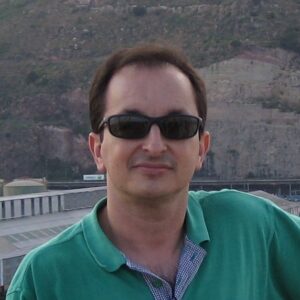
I am a research scientist at Instituto de Astrofísica de Andalucía, in Granada, Spain. My institute belongs to a large national research organization called CSIC. I am a member of the Solar System department within the IAA-CSIC and I belong to the permanent staff. My main area of research is thus within solar system science (from a general astrophysics context, rather than a geophysics or geologic context).
Topics that I work on or worked on in the past are various. My current activities are now more focused on the study of Trans-Neptunian Objects (TNOs) and their role in the early phases of the formation of our Solar System, but I am also interested in comets, some asteroids, other related bodies and even in the formation of other solar systems. In the past, I was more focused on impact processes and for quite some time I studied the jovian planets, which were the subject of my PhD thesis. You can find more details of my activities in my research page.
Selected papers that I authored or co-authored lately
- Albedo and atmospheric constraints of the dwarf planet Makemake from a stellar occultation
- Rotational fission of TransNeptunian Objects: the case of Haumea. Pdf preprint.
- A Pluto-like radius and a high albedo for the dwarf planet Eris from an occultation.
- Short-term variability of 10 TNOs. Pdf preprint.
A nearly complete list of my publications in peer-reviewed journals as compiled by the ADS system can be found here.
Jose-Luis Ortiz

 Email: ortiz@iaa.es
 Phone: (+34) 958 121 311
 Fax:      (+34) 958 814 530

 Instituto de Astrofisica de Andalucia-CSIC Apt 3004, 18080 Granada, Spain